
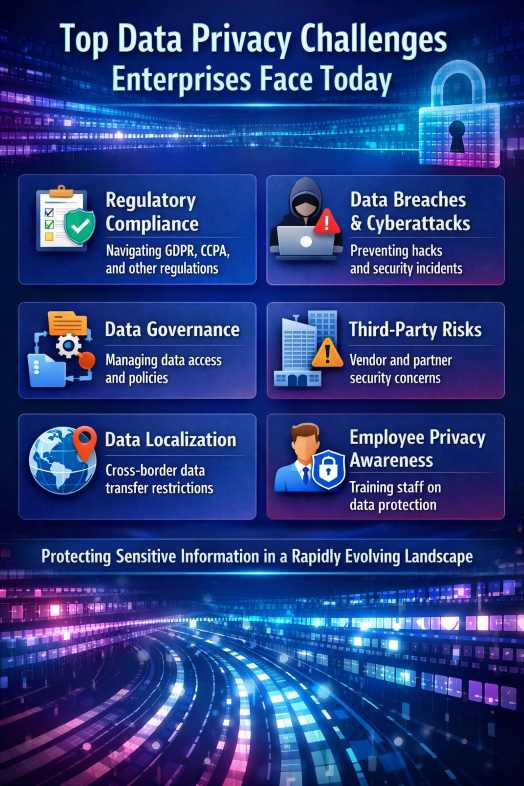
In both India and the U.S., enterprise organisations are operating in an increasingly complex digital environment where information moves around the globe through various devices, applications, partners, and clouds. With increasing regulatory expectations and the growing sophistication of cyber-attacks, organisations face difficulty maintaining control over their most significant asset — data! To build robust, compliant, and future-ready security programs, understanding the key challenges in data privacy compliance will help a leader develop an effective plan for their Enterprise Information Security.
Uncontrolled Data Sprawl
Today, organisations produce and keep data everywhere—from terminals to Software as a Service (SaaS) applications to virtual systems, in-house servers, and public cloud storage. The lack of oversight over this dissemination of information creates gaps in the organisation's overall information security posture that malicious actors can exploit.
These trade-offs include:
- Decentralised data repositories with inconsistent security policies will allow for crossover between sensitive and non-sensitive information.
- Sensitive information is being transferred through personal devices, and shadow IT solutions pose a risk to your data.
- Limited knowledge of who accesses which data and when makes it impossible to confirm proper access.
Solutions provided by AI/ML technologies like Seqrite Data Privacy and Endpoint Security help enterprises to identify, track, and secure the appropriate amount of sensitive data. They create a central point of visibility and enable consistent security policies across multiple environments.
Evolving Consent Requirements
The requirement of a clear justification for collecting personal information and requesting permission from the individual to use their personal data, as mandated by the General Data Protection Regulation (GDPR) in Europe and the Digital Personal Data Protection (DPDP) Act in India, means businesses need to track and manage consent from their users. Unfortunately, many companies struggle with this because they:
- Record consent inconsistently in multiple locations.
- Have difficulty managing consent from its original collection through to its removal at the user's request.
- Keep consent records in separate databases or applications.
To comply with the above laws and strengthen their data privacy compliance, businesses must have a solid approach to managing consent, including implementing an automated workflow system that records, monitors, and audits all consent activity across all applications.
Third-Party and Supply Chain Risks
Access to sensitive enterprise data is frequently granted to vendors, contractors, SaaS providers, and cloud partners. As a result, exposure to an organisation’s data can increase significantly when third parties lack mature security controls.
Some of the main risk factors include:
- Inadequate due diligence was taken on the vendor
- Weak access governance for external users
- Third-party data is not sufficiently monitored throughout the supply chain
Cybersecurity mesh architecture solutions, such as those offered by Seqrite through ZTNA and XDR, offer minimal risk to organisations by enforcing least-privilege policies and providing real-time visibility into threats across the supply chain.
Final thoughts: Enhance your data privacy today
Visibility gaps, consent governance gaps, and the inability to manage third-party vendors can be disastrous for your organisation. Organisations must take data privacy protection seriously, with unified, intelligent controls that focus on endpoints, networks, the cloud, and identity.
Explore Seqrite’s Zero Trust and data privacy challenges for intelligent data protection.